Last Updated: November 8, 2026
Quick Summary
Integrated pest management for condominiums is a prevention-first approach that combines inspection, sanitation, exclusion and targeted treatment into one plan. Instead of scheduled spraying, it monitors, records findings, and uses the least disruptive method that works across shared and private spaces.
- Remove food, water and hiding places before treating any pest problem.
- Check traps and inspect regularly so problems appear early.
- Keep a shared log so the board can see what is working.
- Set a notice rule for routine visits and a faster process for active infestations.
- Review pest logs every six months and adjust the plan.
Table of Contents
- What Integrated Pest Management Means for a Condominium Community
- Who Is Responsible for Pest Control in a Condo: Board, Owners, and Pest Professionals
- How to Build an Integrated Pest Management Plan for Your Building
- IPM Control Methods: Inspection, Sanitation, Exclusion, and Targeted Treatment
- Setting a Condominium Pest Inspection Schedule
- A Step-by-Step Workflow for Responding to a Reported Infestation
- Measuring Your Program and Booking Your First Building Assessment
- Frequently Asked Questions
What Integrated Pest Management Means for a Condominium Community
Integrated pest management for condominiums is a prevention-first approach. Instead of spraying on a schedule and hoping for the best, it combines inspection, sanitation, exclusion and targeted treatment into one plan.
Here is the core idea. A cockroach in unit 4B rarely stays in unit 4B. It moves through shared walls, plumbing chases, trash rooms and laundry areas.
Integrated pest management, usually called IPM, is the framework the U.S. Environmental Protection Agency describes for reducing pest problems while limiting pesticide use (the EPA). Traditional pest control tends to react.
- Prevention first: remove food, water and hiding places before treating
- Monitoring: check traps and inspect regularly so problems show up early
- Targeted treatment: use products only where and when they are needed
- Documentation: keep records so the board can see what is working
Who Is Responsible for Pest Control in a Condo: Board, Owners, and Pest Professionals
Pest responsibility in a condo is split, and most problems start when the split is unclear. The board usually sets policy and budget, owners handle the inside of their units, and a licensed pest professional does the inspections and treatments.
Here is a practical split that many communities use:
- Board: approves the IPM plan, budget, and service contract
- Property manager: schedules inspections and tracks reports
- Owners and tenants: keep units clean, report sightings quickly, and allow access
- Pest professional: inspects, identifies pests, treats, and documents results
Access is where things get tricky. A pest technician often needs to enter a neighbor's unit to stop a spreading problem.
For a deeper look at roles and contracts, see our commercial pest management guide for HOAs.
How to Build an Integrated Pest Management Plan for Your Building
Start with a site survey, not a product order. Walk the common areas, trash rooms, garages, mechanical rooms and a sample of units.
Next, write the plan in four parts: the pests of concern, the monitoring method, the action thresholds, and the response steps. An action threshold is the level of activity that triggers treatment. For example, "three or more cockroaches caught in one monitor in a week triggers a follow-up inspection." Thresholds keep decisions consistent and stop the board from reacting to every complaint with a spray.
Then choose your schedule. Many buildings start with quarterly inspections and move to monthly during warm months or after a problem is found.
Finally, set a review date. Look at the logs every six months and adjust.
For a helpful companion on what a thorough inspection covers, read what a residential wildlife inspection covers.
IPM Control Methods: Inspection, Sanitation, Exclusion, and Targeted Treatment
IPM works best when the methods support each other. Inspection finds the problem, sanitation removes what attracts pests, exclusion blocks their access, and treatment handles what is left. Skipping any one step usually means the problem comes back.
Monitoring and Documenting Pest Activity
Monitoring tells you what is happening before it becomes a crisis. Place sticky traps and bait stations in consistent spots and check them on a set schedule.
A common mistake is checking traps only when someone complains. By then the population has grown. Logged, regular checks give you a trend line you can act on.
Use a simple shared log so the manager, board and technician see the same information. Good records also help you prove that the program is working when you review costs.
Exclusion and Reducing Harborage
Exclusion means sealing the routes pests use to get in and hide. Pests such as cockroaches and rodents can squeeze through openings smaller than most people expect (the EPA).
Harborage is any place pests can hide and breed. Clutter in storage rooms, damp cardboard, and gaps behind appliances all count. Ask residents to keep items off the floor and away from walls, and make sure trash lids close fully.
- Seal gaps around plumbing and electrical penetrations
- Keep trash areas clean, covered, and away from doors
- Remove standing water and fix leaks quickly
- Store food and pet bowls in sealed containers
The article's four core IPM methods work together, and each one addresses a different part of the problem.
| Method | What it covers | Why it matters |
|---|---|---|
| Monitoring | Traps and bait stations checked on a set schedule | Shows problems before they become a crisis |
| Exclusion | Sealing gaps, cracks and entry points | Blocks pests from getting in and hiding |
| Harborage reduction | Clutter, damp cardboard and gaps behind appliances | Removes places pests can hide and breed |
| Sanitation | Food, water and trash control | Removes what attracts pests |
| Targeted treatment | Products used only where and when needed | Limits pesticide use to what is needed |
Setting a Condominium Pest Inspection Schedule
A good inspection schedule matches the risk in your building. Older buildings, buildings near open space, and buildings with food service areas usually need more frequent checks than newer, well-sealed properties.
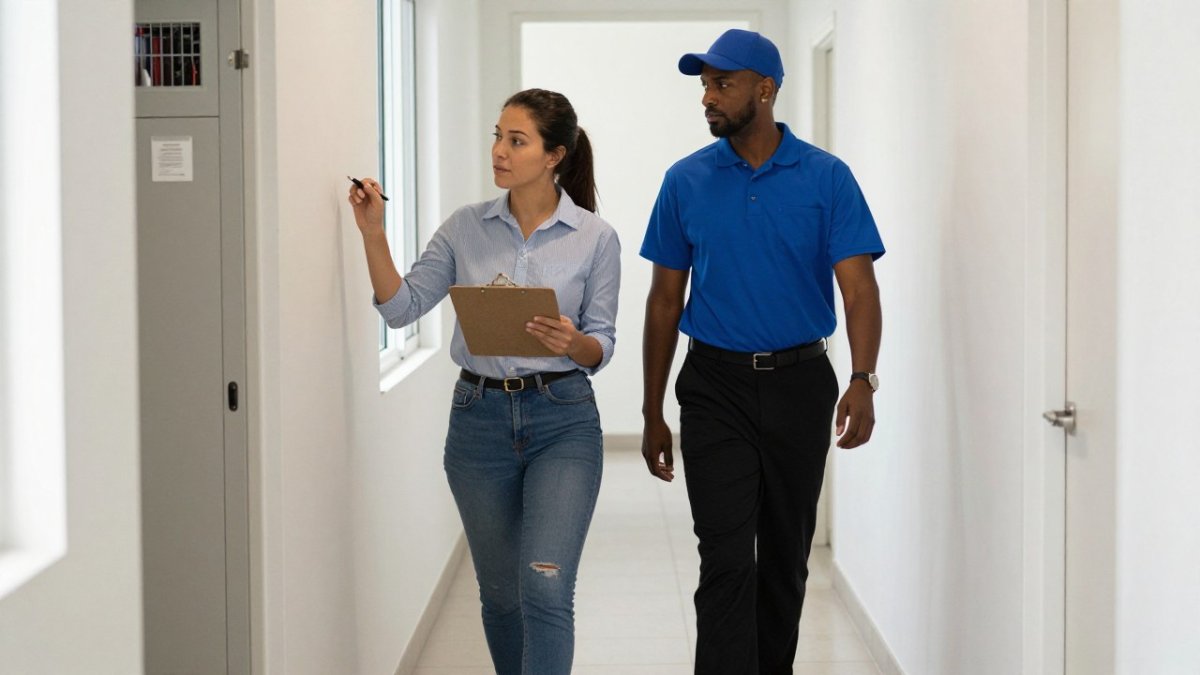
Here is a starting point many boards use:
- Common areas and trash rooms: monthly during warm months, quarterly otherwise
- Mechanical and utility rooms: quarterly
- Sample units: quarterly, rotating through the building
- Full building review: annually
Schedule inspections at times that fit residents' routines, and send notices ahead of time. Ask the technician to leave a short written summary after each visit so the board can track findings over time.
!A property manager and a pest technician walk a clean condominium hallway, clipboards in hand, inspecting baseboards near a utility closet in soft morning light. The man is American.
A Step-by-Step Workflow for Responding to a Reported Infestation
When a resident reports a pest, a clear workflow keeps the response fast, fair, and defensible.
- Log the report the same day. Record the date, unit, pest type as described by the resident, location within the unit, and how the resident prefers to be contacted. Give the report a tracking number so follow-up does not depend on memory.
- Triage by urgency. Not every report needs the same speed. A single ant sighting in a kitchen can wait for the next scheduled inspection. Rodents, cockroaches, bed bugs, and any sighting in a shared wall, trash room, or laundry area should trigger a technician visit within a few business days. A report involving a vulnerable resident, a food-service area, or multiple units at once should escalate to the property manager immediately.
- Confirm the pest. Species identification changes the fix. A technician should confirm what is actually present, because residents often misidentify. Carpenter ants and termites look alike to a worried owner but call for very different responses.
- Inspect the source, not just the unit. Check the reporting unit, the adjoining units on both sides and above and below, and the shared walls, plumbing chases, and utility penetrations that connect them. In multi-unit buildings the source is frequently not the unit where the pest was seen.
- Coordinate access with neighbors, respectfully. When adjoining units must be inspected, send a short written notice that explains the reason, the date and time window, and who will enter. Do not disclose which unit reported the problem or any details about that household. A common pattern is to describe the issue only as "pest activity in the building" and to route all questions to the property manager rather than the reporting resident.
- Treat and seal in the same visit where possible. Use the least disruptive method that fits the species and the location. Treatment without exclusion is the most common reason a report reopens.
- Follow up on a set interval. Recheck in one to two weeks, log trap counts and any new sightings, and confirm with the resident before closing. If activity persists after the follow-up, escalate to a building-wide inspection rather than repeating the same unit-level treatment.
- Close the report in writing. Note what was found, what was done, what was sealed, and the follow-up result. A closed report with a paper trail protects the board if a dispute arises later.
Watch out: skipping the neighbor-coordination step and entering adjoining units without notice is the fastest way to turn a routine pest report into a governance complaint, even when the treatment itself was correct.
Escalation criteria are worth writing down before you need them.
Keep the whole workflow in one shared log so the manager, board, and technician see the same status. That log becomes the raw material for the measurement section below.
Measuring Your Program and Booking Your First Building Assessment
You cannot manage what you do not measure, and most condominium pest programs are never measured at all.
Track these measures from the shared log described in the workflow section:
- Report volume per month, split by pest type and by common area versus private unit. A rising trend in one building or one wing points to a source the current plan is not addressing.
- Time from report to inspection. This is the single most useful service-level measure. If it drifts upward, the contract scope or the response commitment needs review.
- Repeat infestations. Count reports that reopen within 90 days of a closed report. A high repeat rate usually means exclusion or sanitation work is being skipped.
- Trap counts over time. Consistent monitoring locations let you see whether activity is falling, flat, or rising, independent of how many residents happen to complain.
- Exclusion repair completion. Track how many identified entry points were actually sealed and how quickly. Unsealed entry points are the most common cause of a program that looks busy but never gets ahead.
- Treatment recurrence. Note how often the same location is treated for the same pest. Recurrence is a signal to inspect the cause, not to schedule another spray.
Review these with the board quarterly and compare them year over year.
Budgeting and procurement deserve the same discipline. You can also review eco friendly pest control cost ranges and what quotes include before requesting quotes.
If you are ready to start, book a building assessment with Ekoterra Gopher Pest and Wildlife Control. You can request a building assessment to get started.
BUTTON: Book a Building Assessment CARD_TITLE: Is your condo's pest plan working? CARD_TEXT: Ekoterra Gopher Pest and Wildlife Control builds eco-friendly IPM plans for multi-unit communities.
Frequently Asked Questions
Does condo HOA cover pest control?
Usually, yes, for common areas such as hallways, garages, landscaping, trash rooms, and the building exterior, because those are association property. Pest issues inside an individual unit are often the owner's responsibility under the CC&Rs or bylaws, though many associations step in when an infestation spreads through shared walls, plumbing chases, or vents. Read your governing documents first, since the exact boundary varies by association. Pricing for any service depends on building size, the scope of work, and service frequency, so request a written scope and quote from your provider.
How often should a condominium be inspected for pests?
Most integrated pest management programs call for a scheduled inspection of common areas at least quarterly, with more frequent checks in kitchens, trash areas, and buildings with a history of activity. Monthly monitoring is common for food-adjacent spaces. Inspections should be logged with the date, location, pest type, and count, so the board can see whether activity is trending up or down. Your schedule should match the building's risk profile rather than a one-size interval.
Who is responsible for pest control in a condominium?
Responsibility is split. The association typically manages common elements and coordinates building-wide treatment, while individual owners handle the interior of their units under reasonable maintenance expectations. Residents are expected to keep food stored, clean up crumbs, and report sightings promptly. Pest professionals carry out inspections and treatments under the board's contract. Clear written responsibility boundaries prevent most disputes over who pays and who acts.
How can condo residents help prevent pests?
Residents can store food in sealed containers, take out trash regularly, wipe up spills, fix dripping faucets, and avoid leaving pet food out overnight. Reporting a single sighting early, rather than waiting for a larger problem, lets the building respond before pests spread through shared walls. Residents should also allow reasonable access for inspections and treatment in their units, with notice provided, so neighboring units are not left untreated.
