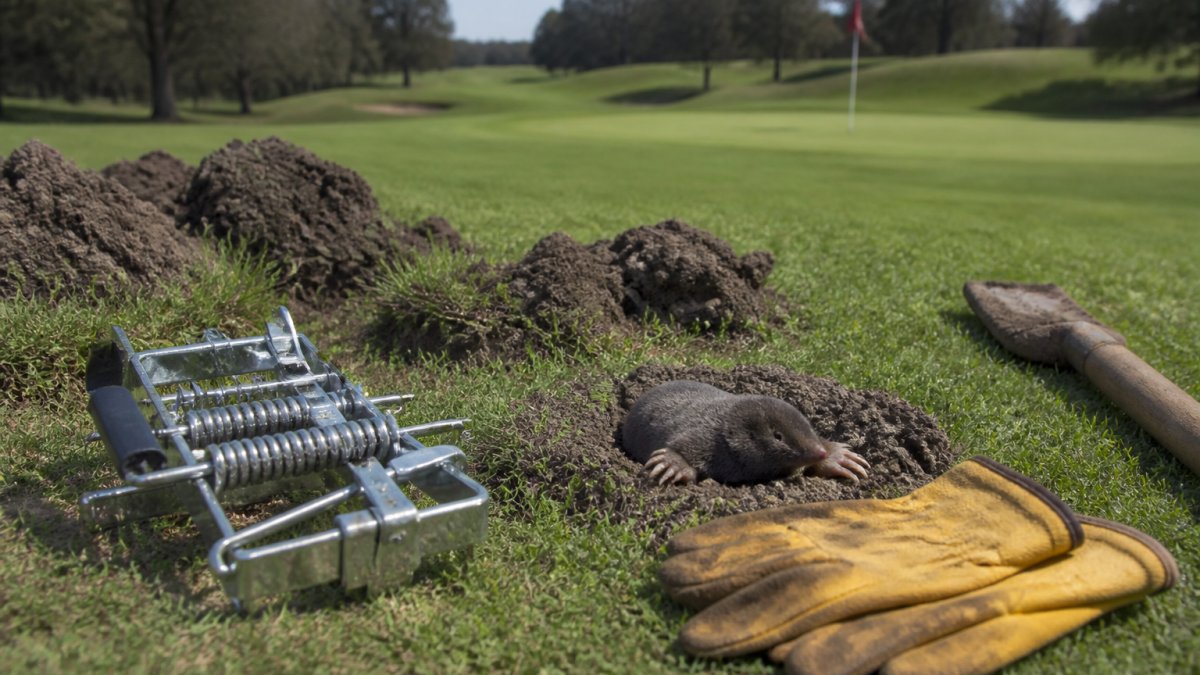
Table of Contents
- Why Gophers Threaten Golf Course Turf and Playability
- How to Identify Active Gopher Tunnels on the Course
- Gopher Trapping for Golf Courses: Direct-Control Methods
- Natural Gopher Control Methods That Fit a Course Setting
- Building a Gopher Control Plan for Golf Course Maintenance
- Method Comparison: Effectiveness, Cost, Labor, and Disruption
- Turf Repair, Prevention, and Golfer Communication
- Frequently Asked Questions
Last Updated: October 21, 2026
Why Gophers Threaten Golf Course Turf and Playability
A single gopher can turn a smooth fairway into a minefield of soft spots and collapsed holes in days. Gopher control for golf courses means finding active tunnels, choosing the right removal method, and repairing damage fast.
Gophers are burrowing rodents that live almost entirely underground, pushing soil onto mowed turf as they dig.
The damage goes beyond appearance:
- Mounds smother grass. A fresh mound buries healthy turf under dirt, and the grass underneath dies.
- Tunnels cave in. A player or mower wheel can drop through a shallow tunnel, which creates a safety risk and a repair job.
- Mowing gets rough. Mower blades hit mounds and dull fast, and uneven ground tears up reels.
Damage compounds over a season: one gopher produces many mounds in a week, and a small population becomes a course-wide problem fast.
Gophers vs. Moles, Voles, and Ground Squirrels
Correct identification decides the whole plan; the wrong method wastes labor.
- Gophers push up fan-shaped or crescent mounds of fine soil. They plug their tunnels, so you rarely see an open hole.
- Moles leave volcano-shaped mounds and raised ridges across the surface. They eat insects, not plants.
- Voles run in shallow surface trails and gnaw stems. They leave narrow runways in the grass.
Treat moles as gophers and the mounds keep appearing. Check mound shape and whether the hole is plugged before committing.
How to Identify Active Gopher Tunnels on the Course
An active gopher tunnel has fresh soil, a plugged opening, and signs of recent digging. Finding active tunnels separates wasted effort from a clean result.
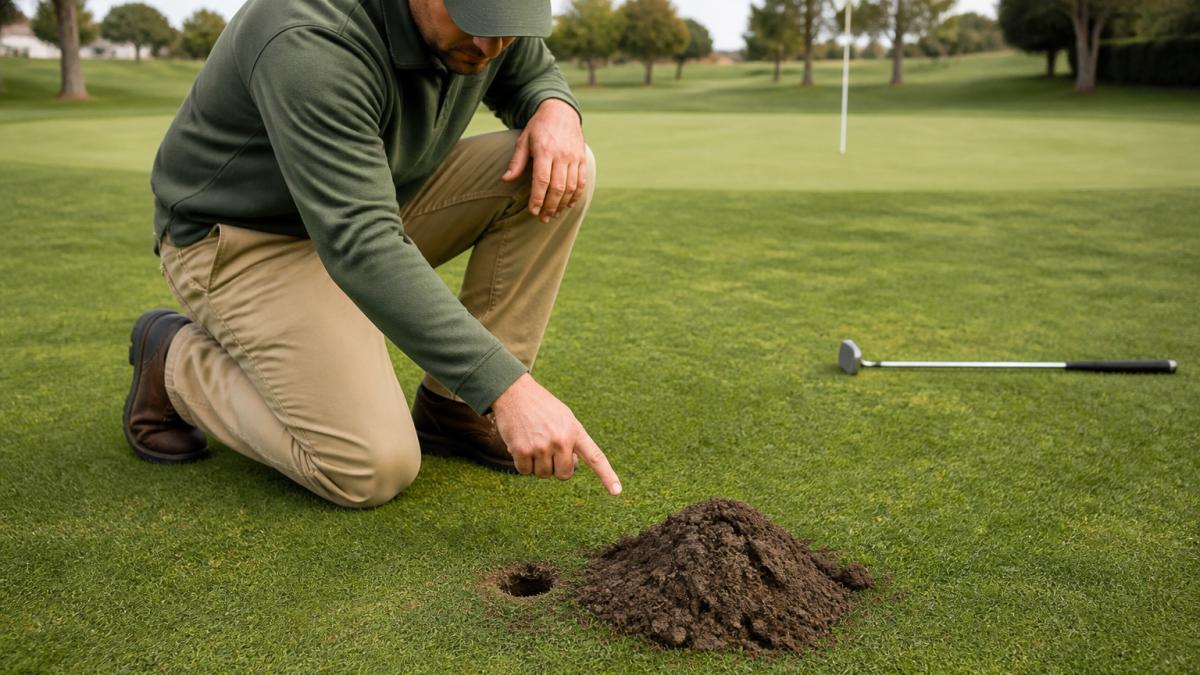
Walk problem areas first, greens, tee boxes, and fairway edges. Look for these signs:
- Fresh soil color. New mounds are darker and damp. Old mounds dry out and fade.
- Crescent or fan shape. Gopher mounds spread out from a plugged hole, not a clean circle.
- No open hole. A plugged tunnel opening is the clearest gopher sign.
Flag each active mound and return the next day to check which have new soil. Those are worth treating; inactive tunnels may be abandoned.
Monitoring matters more than any single treatment: weekly tracking of fresh mounds spots new activity before it spreads.
Gopher Trapping for Golf Courses: Direct-Control Methods
Trapping is the most reliable direct-control method for gophers on a golf course: it removes the animal and works on the specific tunnel you have located.
No 'Caddyshack' explosions: Raptors help Bend golf course with gopher problem
Central Oregon Daily News
Here is how a crew should approach it:
- Find the main tunnel. Probe about 30 cm to the side of a fresh mound with a metal rod. The main runway drops and runs parallel to the surface.
- Open the tunnel cleanly. Dig a small hole into the runway and clear loose soil from the opening.
- Set the trap in the runway. Place it facing into the tunnel and anchor it with a stake so it stays put.
- Cover the opening. Block light and airflow so the gopher returns to close the tunnel.
- Check daily. Inspect traps each morning and reset as needed.
Trapping takes skill: a crew member who can read a tunnel catches more gophers in a morning than a day of guesswork.
Flooding, Gas, and Carbon Monoxide Treatments
Flooding and gas treatments get attention, but both have real limits.
Flooding runs water into a tunnel to force the gopher out.
Gas and carbon monoxide treatments use cartridges or engine exhaust to fill a tunnel. They depend on a sealed tunnel system, and gopher tunnels are often open and branching, so results vary widely.
Label directions and local wildlife rules govern any gas product. Check the product label and your state wildlife agency before use.
Natural Gopher Control Methods That Fit a Course Setting
Natural gopher control methods appeal to courses limiting chemical use, but most home remedies fall short at scale.
Common options include:
- Repellents and deterrents. Castor oil products and similar repellents may push gophers away from a small area, but they do not remove the population. Expect to reapply.
- Coffee grounds and gum. These home remedies get repeated online. There is little reliable evidence they work at scale, and on a course they are impractical to apply.
- Buffer strips and planting choices. Removing favored food plants near greens and fairways can reduce activity. Gophers eat roots and bulbs, and annual grains and some ornamentals draw them in.
Natural methods work best as support, not the main plan: use them to protect sensitive spots and pair them with direct control where gophers are established.
For courses that want an eco-conscious approach, a professional assessment helps decide which methods fit the site.
Building a Gopher Control Plan for Golf Course Maintenance
A gopher control plan for golf course maintenance turns scattered fixes into a repeatable program. The strongest version follows an integrated pest management (IPM) structure, monitor, identify, set thresholds, treat, verify, repair, which also lets you defend the program to ownership, regulators, and players.
Build it in these parts:
- Map the problem. Mark active tunnels and damage zones on a course map, keyed to hole number and feature (green, tee, fairway, rough). Update the map weekly during active season.
- Set action thresholds. Decide in advance how many fresh mounds per zone per week triggers treatment. A common pattern is to treat a zone when fresh mound counts rise for two consecutive weekly checks, rather than reacting to a single mound.
- Assign roles. Name who monitors, who treats, who repairs turf, and who communicates with the pro shop. One accountable lead per area prevents gaps.
- Verify treatment. Recheck treated tunnels within 48-72 hours. A treated tunnel with no new plug and no fresh soil is a probable success; a re-plugged tunnel means the animal survived and needs a second attempt.
- Repair and reseed. Fill collapsed tunnels, level mounds, and patch bare spots before the next tee time.
- Review monthly. Compare fresh mound counts, repeat-treatment rates, and repair hours. Adjust method mix where activity persists.
Legal, Label, and Wildlife-Regulation Requirements
Gopher control on a golf course is subject to more rules than most crews assume. Build compliance into the plan.
- Pesticide labels are law. Any repellent, fumigant, or toxicant must be applied exactly as its EPA-registered label directs, rate, placement, buffer distances, and personal protective equipment. The label is the legal document, not a suggestion.
- Applicator certification. Restricted-use products require a certified applicator or someone under direct supervision. Confirm certification status before the season starts.
- State wildlife rules. Some states classify gophers as protected wildlife or regulate take methods and seasons. Check with your state wildlife agency before adopting a new method.
- Humane-treatment obligations. Many states have animal-cruelty statutes that apply to wildlife control. Trapping methods and check intervals should reflect humane standards and any state requirements.
Method Comparison: Effectiveness, Cost, Labor, and Disruption
No single method wins on every measure. The right choice depends on infestation size, labor hours, permitted product labels, and how much play disruption the course can absorb.
| Method | Effectiveness | Typical Labor per Treated Tunnel | Relative Material Cost | Course Disruption | Best For |
|---|---|---|---|---|---|
| Trapping (body-grip or box traps) | High when tunnels are read well | 10-20 minutes to set, 5 minutes daily to check | Low (reusable traps) | Low, small holes, flag and move on | Targeted removal in hot zones |
| Flooding | Low in drained turf; moderate in sandy soil | 15-30 minutes per tunnel | Low (water only) | Moderate, muddy surface, water use | Light, sandy soils; small isolated tunnels |
| Gas / carbon monoxide cartridges | Variable; depends on sealed tunnel | 10-15 minutes per tunnel plus recheck | Moderate (cartridges) | Low to moderate | Sealed tunnel systems away from play areas |
| Repellents (castor oil, thiram-based) | Low, short-term | 5-10 minutes per application | Low to moderate | None | Protecting small sensitive areas |
| Habitat and planting changes | Low as a standalone | Project-level, not per tunnel | Variable | None after establishment | Long-term prevention at turf edges |
| Professional integrated program | High when monitored | Bundled | Contract-based | Managed around play schedule | Courses with recurring pressure |
How to read the trade-offs.
- Effectiveness vs. verification. Trapping is the only method with immediate confirmation, a caught animal, so it doubles as monitoring. Gas and repellents require inferring success from the absence of new mounds.
- Labor shape, not just labor total. Trapping front-loads skilled labor, then costs a few minutes a day per trap line. Flooding and gas are quick per tunnel but often need repeat visits because they fail more often.
- Disruption windows. Schedule trapping and gas work for early morning before the first tee time, or on maintenance Mondays when play is lightest. Flooding should be avoided on greens and approaches entirely, the surface damage usually costs more to repair than the gopher did.
- Label and legal constraints. Any gas, fumigant, or repellent product must be applied according to its EPA-registered label and any state or local restrictions. Some are restricted-use and require a certified applicator. Check the label and your state pesticide regulatory agency before purchase.
A practical decision rule. For a small, newly detected infestation, start with trapping in flagged tunnels and monitor weekly. For steady pressure across zones, combine trapping in hot zones with habitat changes at the edges and a monitoring rotation everywhere.
Turf Repair, Prevention, and Golfer Communication
Repair is part of gopher control, not an afterthought. Fix the surface before the next tee time.
Repair steps:
- Remove the mound. Scoop the soil back and spread it thin.
- Fill the tunnel. Pack soil into the collapsed tunnel so it does not sink again.
- Re-seed or sod. Patch bare spots with matching seed or sod.
- Level and water. Tamp the area flat and water it in.
Prevention means keeping the edges less inviting: manage buffer strips, watch new plantings, and keep monitoring.
Communication matters too.
If gophers keep coming back despite your crew's best efforts, a professional wildlife control plan can help.
Gophers will keep testing your turf, and a scattered approach will keep losing ground.
Frequently Asked Questions
What damage can gophers cause to golf greens and fairways?
Gophers push up mounds of soil that smother mowed turf and create uneven lies on fairways and greens. Their tunnels hollow out the root zone, so mowers and carts can collapse the surface, and the exposed soil invites weeds. On putting surfaces, a single mound means lost playability and repair work. Because gophers dig constantly, damage compounds quickly across a course, which is why gopher control for golf courses has to be ongoing rather than a one-time fix.
How deep do gopher tunnels go?
Most feeding tunnels sit shallow, often within the top foot of soil where roots and bulbs are, while deeper nesting and travel tunnels can run several feet down. That shallow feeding zone is why surface damage shows up so fast on fairways and greens. When identifying active gopher tunnels, probe beside fresh mounds rather than digging into the middle of one; the plugged lateral tunnel is usually the one worth treating.
Are natural gopher control methods effective on golf courses?
Natural methods work best as part of a plan, not a standalone cure. Habitat changes like removing brushy buffer strips and managing irrigation help reduce attraction, and repellents or barriers can protect specific beds and greens surrounds. Home remedies such as coffee grounds or gum are widely repeated but unreliable at course scale. A gopher control plan for golf course maintenance should pair natural deterrents with direct removal so populations stay low.
When should a golf course hire a professional gopher control service?
Call a professional when mounds keep reappearing after in-house trapping, when damage reaches greens or irrigation lines, or when staff time and safety training become the bottleneck. Professionals bring licensed methods, documented monitoring, and consistent scheduling across the whole property. For courses in Ventura, Los Angeles, and Santa Barbara Counties, a provider experienced with eco-friendly wildlife control can help.