Table of Contents
- Why Gophers Threaten Commercial Landscaping Budgets
- Signs of Gopher Activity Every Property Manager Should Know
- Gopher Barriers for Landscaping: Mesh, Depth, and Installation
- Gopher-Resistant Plants and Pre-Planting Protection
- Commercial Gopher Control: Trapping, Baiting, and Method Selection
- Building a Monitoring and Maintenance Protocol for Large Properties
- Safety, Regulations, and Non-Target Impacts
- Conclusion: A Site-Scale Prevention Plan That Holds
- Frequently Asked Questions
Last Updated: October 14, 2026
Why Gophers Threaten Commercial Landscaping Budgets
Preventing gophers in commercial landscaping is a budgeting discipline as much as a groundskeeping one. A single pocket gopher can move several tons of soil a year, and on a managed property that translates into damaged turf, undermined irrigation, and plant loss that shows up on next quarter's maintenance invoice. Ekoterra Gopher Pest and Wildlife Control treats gopher prevention as a site-scale program: identify the pressure, deny the access, and verify the result.
How Burrowing Rodents Damage Turf and Plantings at Scale
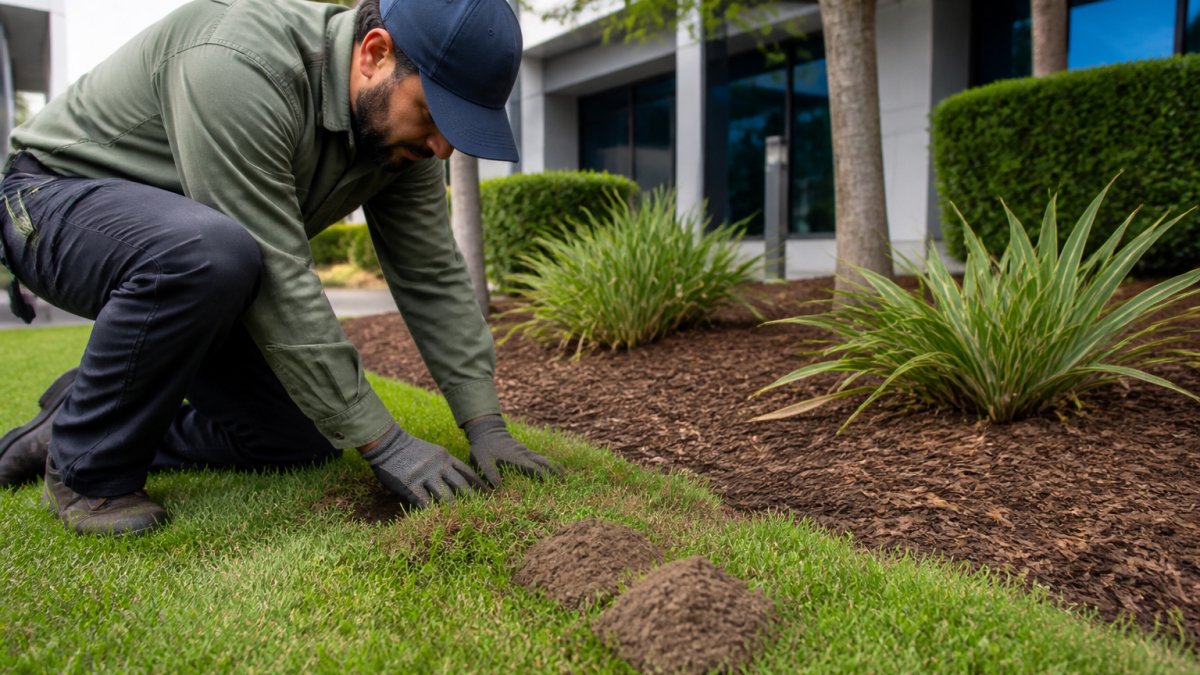
Pocket gophers are burrowing rodents that live almost entirely underground, feeding on plant roots and pushing excavated soil to the surface through tunnel openings. On a golf course, HOA greenbelt, or commercial campus, a handful of animals can produce dozens of mounds across a single fairway or planting bed.
The damage compounds in three ways:
- Turf damage from soil pushed up under mown grass, which dulls mower blades and creates scalped, dead patches
- Plant damage where roots are clipped below the crown, killing shrubs and perennials that looked healthy days earlier
- Infrastructure damage when tunnels run under irrigation lines, paving edges, and retaining walls
For a property manager, the visible mound is the cheap part. The expensive part is the replacement planting, the irrigation repair, and the labor hours spent chasing symptoms instead of the source.
Signs of Gopher Activity Every Property Manager Should Know
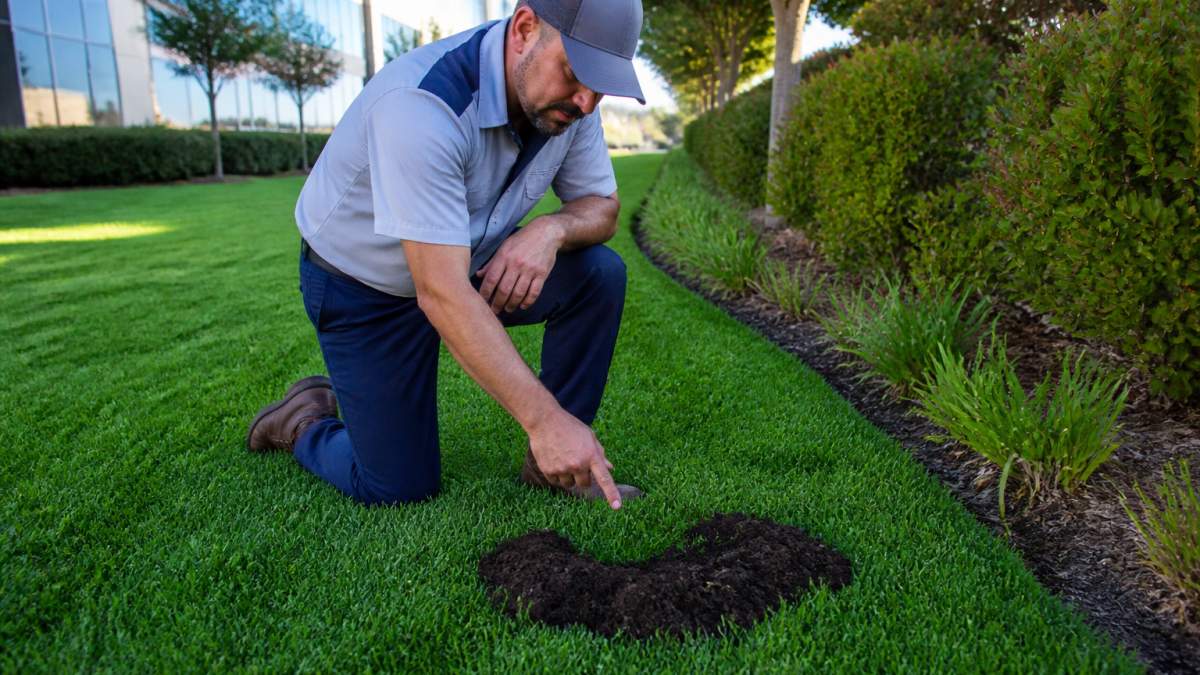
The clearest sign of gopher activity is a crescent-shaped mound of fresh soil with a plugged hole off to one side. Grounds crews should be trained to log these on sight, because early detection is what separates a two-week response from a two-season problem.
Reading Mounds, Fresh Soil, and Active Tunnels
Mounds are the surface signature of burrowing. A gopher plugs the tunnel opening with soil from below, so a mound with a visible plug is likely recent. Fresh soil is darker and softer than surrounding ground; if it crumbles easily underfoot, the animal is still working that run.
To confirm active tunnels, probe the soil beside a fresh mound. A probe that drops suddenly into a void has found a run. Mark it, date it, and check it again in 48 hours. Runs that stay plugged are dormant; runs that reopen are live. That distinction matters, because treating dormant tunnels wastes product and labor.
Gopher Barriers for Landscaping: Mesh, Depth, and Installation
Gopher barriers for landscaping are physical exclusion systems, usually underground barriers of wire mesh or hardware cloth, installed to stop burrowing into a protected zone. They are the only method that prevents damage rather than responding to it.
Barriers work best in three applications:
- Raised beds and garden beds, where mesh lines the floor and sides
- Root barriers around specimen trees and high-value plantings
- Perimeter fencing for turf areas, installed with a buried skirt
Choosing the Right Mesh Size and Material
Mesh size decides whether a barrier actually excludes gophers. Chicken wire is a common mistake: its openings are large enough for young gophers to pass, and it corrodes quickly in soil. Hardware cloth with smaller openings is the more reliable choice for pre-planting protection, and galvanized or stainless material lasts longer underground.
| Barrier Material | Typical Use | Key Limitation |
|---|---|---|
| Chicken wire | Light, temporary beds | Openings too large; rusts fast |
| Galvanized hardware cloth | Raised beds, root balls | Must be buried deep enough |
| Stainless mesh | High-value, long-term sites | Higher material cost |
| Buried perimeter skirt | Turf and greenbelt edges | Requires trenching equipment |
Depth matters as much as material. A barrier that stops short of the animals' working depth simply gets bypassed from below. Install the mesh vertically with a return lip at the top, and overlap seams rather than butting them together.
Gopher-Resistant Plants and Pre-Planting Protection
Gopher-resistant plants reduce pressure but never eliminate it. On a commercial site, plant selection is a planning decision that belongs in the design phase, not a maintenance afterthought. Plants with fibrous, dense root systems and those that produce less appealing underground tissue tend to be hit less often than soft-rooted favorites. Daffodils, lavender, and certain sages are commonly planted as deterrents in mixed borders, but their effect is local and temporary.
Treat plant selection as one layer, not a solution. Pair it with pre-planting protection: line the planting hole and the bed floor with mesh before the soil goes back in. Retrofitting a barrier around an established landscape costs far more than installing it at planting time. For commercial properties, the cost difference is not just materials, it is the labor to remove established plantings, re-excavate, and reinstall, often during peak season when crew hours are already committed.
Site-Scale Plant Planning for Commercial Properties
A site-wide plan should map gopher pressure zones before plant selection. High-value beds near turf edges, irrigation lines, and retaining walls are the most vulnerable. In these zones, specify plants with fibrous roots and avoid soft-rooted favorites like certain bulbs and succulents. For large campuses, HOAs, and parks, group resistant species in perimeter buffers and use them to create a less attractive barrier around specimen plantings.
Pre-planting protection should be integrated with irrigation and drainage design. Install mesh barriers before irrigation lines are trenched, and overlap seams with adjacent hardscape barriers. This prevents gophers from bypassing the barrier at utility penetrations. On raised beds and protected planting areas, line the entire bed floor and sides with galvanized hardware cloth, and extend the mesh vertically at the edges to meet any perimeter skirt.
Cost and Lifecycle Considerations
Barrier installation at planting time typically costs less than retrofitting because it avoids demolition and re-planting. For commercial budgets, factor in material cost, trenching equipment, and labor hours. A common pattern is that the upfront cost of mesh and installation is recovered within one or two replacement cycles of high-value plantings. Track plant replacement costs by zone to justify barrier investment in future phases.
For properties with specific compliance obligations, document plant selection and barrier installation as part of the site's IPM plan. This record supports budget requests and demonstrates due diligence if damage recurs.
Commercial Gopher Control: Trapping, Baiting, and Method Selection
Commercial gopher control should follow an integrated pest management sequence: monitor, exclude, then reduce the population with the least risky effective method. Trapping is the most targeted option for small, sensitive, or high-traffic sites because it removes specific animals without leaving residue in the soil.
Metal traps set in active tunnels work when trap placement is precise. The trap goes in the main run, not a side branch, and it must be covered to block light. Check sets daily. Bait and poison pellets can be effective on larger properties, but they carry non-target risk for pets, wildlife, and children, which makes them a poor fit for hospitality grounds, schools, and residential common areas.
Sprays and tunnel drenches are the most overrated category. They may irritate animals in the short term, but they do not remove a population, and repeated applications add cost without resolving the source.
For large yards, commercial property, and multi-building sites, the practical answer is usually a combination: exclusion at the perimeter, targeted trapping inside it, and a monitoring routine that catches reinvasion early. That is the model Ekoterra Gopher Pest and Wildlife Control uses, and it is why they lead with site assessment rather than a single product.
Building a Monitoring and Maintenance Protocol for Large Properties
A monitoring protocol turns gopher management from reactive firefighting into a scheduled line item. The core elements are a mapped route, a fixed inspection frequency, and a written record of every mound, set, and result.
A workable weekly cycle for a commercial site:
- Walk the mapped route and log new mounds and tunnel openings
- Probe and flag active tunnels; date each flag
- Service traps and record catch or non-catch
- Inspect barrier edges for breaches and root intrusion
- Update the site map and review trends monthly
Measure outcomes, not activity. Track mounds per acre per month, repeat infestation in treated zones, and plant replacement costs. If mound counts are flat while trap service hours climb, the method is not working and the plan needs revision.
Safety, Regulations, and Non-Target Impacts
Safety and regulatory compliance decide which methods are even available on a given site. Bait and poison pellets are regulated pesticides, and their use is restricted by label directions and by state and federal rules. Always read and follow the label; it is the legal document that governs application.
Non-target impact is the practical concern. Rodenticides can harm pets, raptors, and other wildlife that scavenge or prey on affected animals. On properties with children, dogs, or food service operations, the risk profile usually rules out bait in favor of exclusion and trapping. Check current federal and state guidance before selecting any pesticide, and confirm local restrictions for your jurisdiction.
For properties with specific compliance obligations, such as food service or hospitality, document every treatment, product, and date. An inspection-ready log is worth more than a verbal assurance.
Conclusion: A Site-Scale Prevention Plan That Holds
Gopher pressure on a commercial property never resolves on its own, and the cost of waiting shows up as replacement plantings, irrigation repairs, and crew hours. The properties that stay ahead of it share the same approach: exclusion first, targeted removal second, and a monitoring routine that never stops.
Ekoterra Gopher Pest and Wildlife Control builds that plan around your site, using eco-friendly methods, guaranteed results, and a service model designed to protect your family, your tenants, and the environment. If you manage a campus, HOA, golf course, or hospitality property and want a prevention plan that holds, get started with Ekoterra Gopher Pest and Wildlife Control and put a measurable gopher program in place.
Frequently Asked Questions
How do you keep gophers out of a commercial landscape?
Preventing gophers in commercial landscaping combines three layers: underground barriers of galvanized wire mesh with openings no larger than 3/4 inch, gopher-resistant plantings in beds and raised planters, and scheduled monitoring of active tunnels. For large properties, integrated pest management pairs physical exclusion with trapping or baiting where burrowing rodents break through. A written protocol assigning inspection frequency, mapping tunnel openings, and logging fresh soil sightings keeps the program measurable instead of reactive.
How often should a commercial property be checked for gophers?
Most commercial properties need inspections every one to two weeks during peak burrowing season, and monthly during slower periods. Golf courses, equestrian centers, and properties with extensive turf or garden beds should stay on the shorter end because turf damage spreads quickly once tunnels connect. Each visit should record new mounds, reopened tunnel openings, and any plant roots disturbed. Properties with a history of infestation benefit from weekly checks until activity drops to zero for four consecutive weeks.
Can gophers get through chicken wire?
Yes. Standard chicken wire has openings of 1 inch or more, and gophers can push through or chew past it within a season. Galvanized hardware cloth with 1/2 inch or 3/4 inch openings, buried at least 18 to 24 inches deep with a 6 inch outward lip at the top, is the reliable choice for gopher barriers for landscaping. Chicken wire may slow surface digging briefly, but it does not stop burrowing rodents from entering raised beds or plant roots.
When should a property manager call a professional gopher control service?
Call a professional when activity appears in more than two zones, when damage recurs after in-house trapping, or when the property has compliance or safety obligations such as food service, HOA common areas, or historic structures. Commercial gopher control providers bring tunnel mapping, calibrated bait placement, and documented follow-up that in-house crews rarely have time for. A written service log also helps demonstrate due diligence for inspections, insurance, or HOA reporting requirements.