Table of Contents
- How to Stop Gophers Damaging Lawn: What You'll Need
- How to Get Rid of Gophers in Lawn: Step-by-Step
- Gopher Traps for Lawns: Pros, Cons, and Setup
- Natural Gopher Repellents: What Works and What Doesn't
- Professional Gopher Control: When DIY Isn't Enough
- Common Mistakes That Let Gophers Return
- Frequently Asked Questions
Last Updated: October 12, 2026
How to Stop Gophers Damaging Lawn: What You'll Need
Learning how to stop gophers damaging lawn starts with the right tools and a clear plan. At Ekoterra Gopher Pest and Wildlife Control, we handle gopher problems across Ventura, Los Angeles, and Santa Barbara Counties every week, and the same three mistakes show up again and again.
Gophers are small, but the damage they cause is not. A single gopher can push up dozens of mounds in a season and wreck the roots under a healthy lawn. Most homeowners waste weeks on fixes that never touch the real problem.
Here is what you actually need before you start:
- A probe: a thin metal rod or long screwdriver to find tunnels
- Sturdy gloves: gophers bite, and they bite hard
- Traps or controls: depending on the method you choose
- Marking flags: to track which tunnels you've treated
- A plan: because random digging never works
Below, we break down each step, the pros and cons of every method, and when it's time to call in help.
How to Get Rid of Gophers in Lawn: Step-by-Step
Getting rid of gophers in your lawn comes down to three steps: confirm it's gophers, find the active tunnels, then set traps or apply controls. Skip a step, and you're guessing.
Step 1: Confirm Gophers, Not Moles
Gophers and moles leave different clues, and mixing them up wastes time and money.
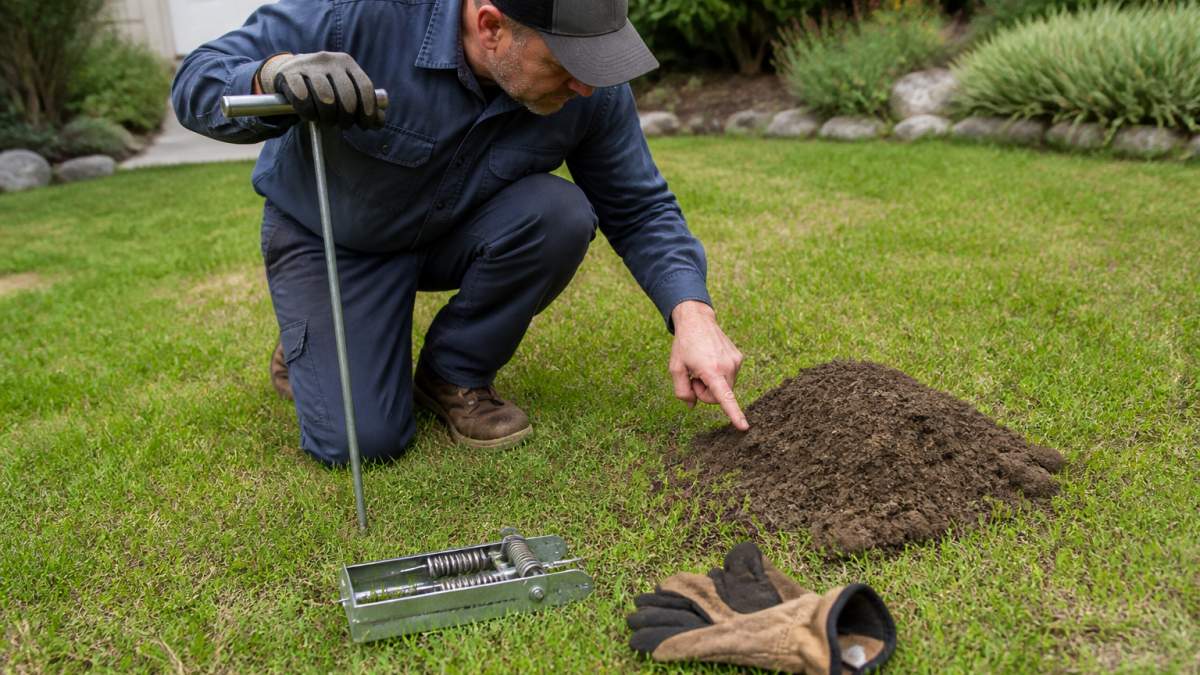
Gophers leave fan-shaped mounds with a plugged hole off to one side. They eat plants and roots. Moles leave volcano-shaped mounds with no visible hole, and they eat insects, not your lawn.
Check the mound shape first. If you see a plugged hole, you're dealing with gophers.
Step 2: Locate Active Tunnels
Active tunnels are the ones you treat. Old tunnels are a waste of effort.
Probe about 6 to 12 inches from a fresh mound. When the rod gives way, you've found a tunnel. Mark it with a flag. Then check the next day: if the plug is pushed back out, that tunnel is active.
Step 3: Set Traps or Apply Controls
For traps, set them in the main tunnel, not the side branch, and cover the hole to block light. Check them daily.
For repellents or other controls, follow the label exactly. Placement matters more than the product itself.
Gopher Traps for Lawns: Pros, Cons, and Setup
Traps are the most reliable DIY method for gopher traps for lawns, but only when you set them correctly. A poorly placed trap catches nothing.
Pros:
- Fast results when placed in active tunnels
- No chemicals, so they're safe around kids and pets
- Low cost compared to ongoing treatments
Cons:
- You have to handle the animal
- Results depend on tunnel accuracy
- Not ideal if you're squeamish
Setup basics:
- Find an active tunnel with your probe
- Dig down to expose the runway
- Place two traps facing opposite directions
- Cover the opening with dirt or a board
- Check every morning
If traps sit untouched for three days, move them. You're in the wrong tunnel.
Natural Gopher Repellents: What Works and What Doesn't
Natural gopher repellents get mixed results, and the honest answer is that no repellent is a guaranteed fix. Some help. Some do nothing.
What tends to help:
- Castor oil sprays: can make soil less appealing, but need repeat use
- Ultrasonic stakes: work in some yards, ignored in others
- Plant barriers: gophers often avoid certain plants, though results vary
What usually fails:
- Chewing gum, broken glass, or hair clippings
- One-time applications of anything
- Repellents used without finding the tunnels first
Repellents work best as a backup, not a cure. If the population is established, they rarely solve it alone.
For guidance on safe use of any control product around pets and children, check the EPA pesticide safety information.
Professional Gopher Control: When DIY Isn't Enough
Professional gopher control makes sense when traps and repellents haven't worked, or when the problem keeps coming back. Some yards are just too big or too active for DIY.
Signs it's time to call in help:
- New mounds keep appearing after treatment
- You've tried multiple methods with no luck
- The property is large, or you manage multiple units
- You need guaranteed, repeatable results
At Ekoterra Gopher Pest and Wildlife Control, we use eco-friendly methods built around your property, your family, and your pets. Every job comes with guaranteed results, so the problem doesn't just get masked, it gets solved.
For homeowners with kids and dogs, this matters. You want to know exactly what's being used and why. That's the standard we hold ourselves to.
Common Mistakes That Let Gophers Return
Gophers come back for one reason: the job wasn't finished. Here are the mistakes we see most.
- Treating only the visible mounds. The tunnels are the real target.
- Using repellents as a one-time fix. They need consistent reapplication.
- Ignoring new activity. One missed gopher can repopulate a yard.
- Skipping the perimeter. Gophers move in from neighboring land.
- Giving up too early. Some methods take a week or more to show results.
Fix these, and your results improve fast.
The University of California agriculture guidance on vertebrate pests notes that gopher control works best when it's ongoing, not a one-off event.
Frequently Asked Questions
How can I stop gophers from damaging my lawn?
Stop gophers by targeting active tunnels with traps or professional control, not just treating the surface. First confirm gopher damage (crescent-shaped mounds, no visible holes) versus mole damage. Locate active runs by probing 6-12 inches from fresh mounds, then set traps or call a professional. Because gophers are solitary and territorial, removing the resident gopher often ends damage until a new one moves in. Monitor monthly, especially in spring and fall when activity peaks.
Do natural gopher repellents actually work?
Natural gopher repellents vary widely. Castor oil-based sprays and granular repellents can discourage gophers temporarily, but they do not remove an established population. Ultrasonic devices and plants like gopher spurge have little consistent effect in practice. For lasting results, combine repellents with trapping or professional gopher control. If you use repellents, reapply after rain or irrigation and focus on tunnel entrances and perimeter beds.
When should I call a professional for gopher control?
Call a professional when DIY traps fail after 1-2 weeks, when gophers return repeatedly, or when damage affects large lawns, HOAs, golf courses, or historic properties. Professional gopher control uses proven methods, proper trap placement, and follow-up monitoring. It also provides documentation and guarantees that DIY approaches cannot. For eco-conscious properties, ask about non-poison options and integrated pest management plans.
Will gophers come back after they are removed?
Yes, gophers can return. Gophers are solitary, so removing one often solves the immediate problem, but vacant tunnels attract new gophers from adjacent areas. To prevent reinfestation, monitor for fresh mounds weekly for the first month, then monthly. Keep perimeter areas less inviting by reducing dense ground cover and maintaining consistent control. Professional gopher control programs include ongoing monitoring to catch new activity early.
Gophers don't stop on their own, and a half-finished job just means they return next season. If you're tired of guessing and want a plan that actually holds, Ekoterra Gopher Pest and Wildlife Control can help. Our eco-friendly methods protect your family, your pets, and your lawn, backed by guaranteed results. Get started with Ekoterra Gopher Pest and Wildlife Control and take back your yard for good.