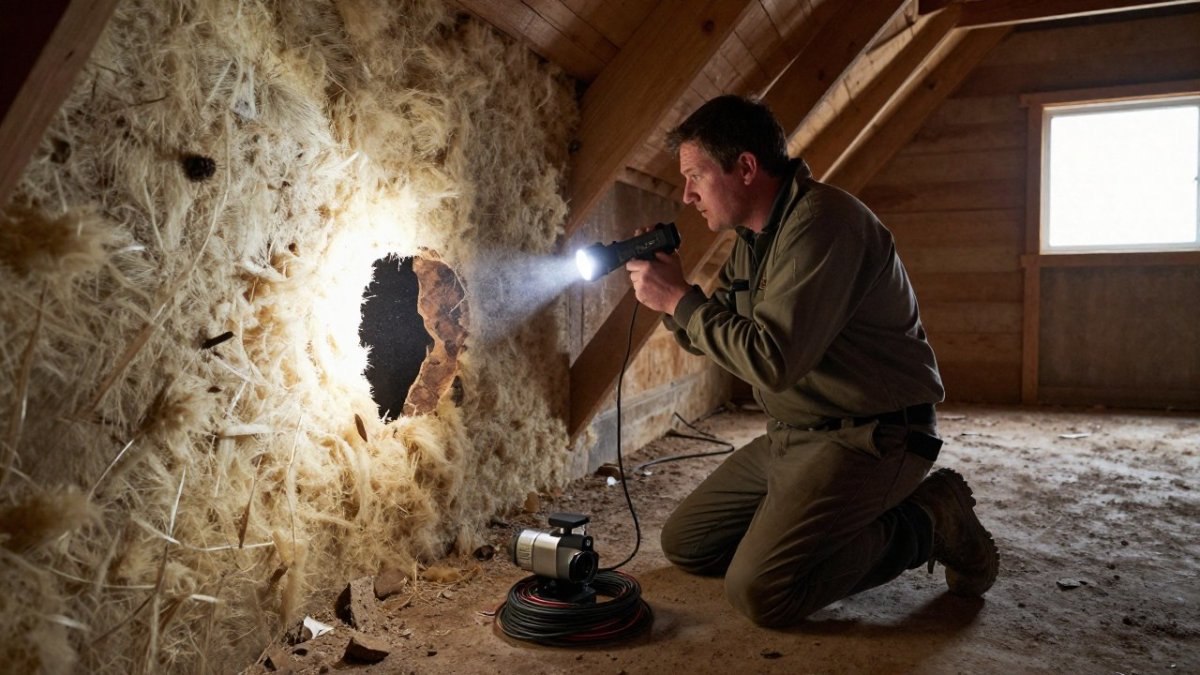
Last Updated: November 11, 2026
Quick Summary
Signs of rodents inside wall cavities include scratching, scurrying and pattering at night, along with droppings, gnaw marks and musty or ammonia-like odors. Rats leave larger droppings and wider gnaw marks than mice. If the activity continues after you check for these signs, contact a professional.
- Mouse droppings are rice-sized with pointed ends, while rat droppings are larger and blunt.
- Rats chew through wood, pipe and cable, leaving wider and deeper gnaw marks than mice.
- Listen for activity between dusk and early morning, noting times and locations over two or three nights.
- Never sweep droppings into the air, and wear gloves and a mask when inspecting them.
- Chewed electrical wiring is a fire risk, so treat it as urgent.
Table of Contents
- What Rodent Activity in a Wall Cavity Sounds Like
- How to Tell If You Have Rats in Your Walls
- Droppings, Gnaw Marks and Nesting Material
- Rats in Walls but Not in the House: Why It Happens
- Rodent Infestation Signs and Odors to Check For
- Signs of Rats in the House at Night
- Inspecting Without Opening the Wall, and When to Call a Professional
- Frequently Asked Questions
Signs of rodents inside wall cavities usually show up as sounds, droppings, gnaw marks and odors long before you see a mouse. Ekoterra Gopher Pest and Wildlife Control serves homeowners across Ventura, Los Angeles and Santa Barbara Counties. Rodent activity inside a wall void is a rodent living in a space you cannot see, so the clues are what you have to work with. Below, we walk through each clue, how to tell rodents from plumbing or heating noise, and when to call a professional.
What Rodent Activity in a Wall Cavity Sounds Like
Scratching and scurrying are the most common signs. For a sense of what a professional check covers and costs before you book one, see what a residential wildlife inspection covers. Rodents often move inside wall spaces at night, when the house is quiet.
Scratching, scurrying and pattering at night
The noise usually comes in short bursts. You may hear light scratching, quick running, or a soft pattering as an animal moves along a stud or pipe.
- Sounds are most noticeable between dusk and early morning
- Noise often moves from one spot to another within minutes
- Activity may stop when a light is switched on, then start again
Telling rodent noises from plumbing and heating sounds
Many wall noises are not animals. Water hammer, expanding pipes and heating ducts all make sounds that can be mistaken for rodents.
- Pipes knock when water is turned on or off, and the noise stops fast
- Ducts tick as they heat up or cool down, often at set times
- Rodent sounds are irregular and move around, not on a fixed schedule
How to Tell If You Have Rats in Your Walls
Rats and mice leave different evidence, and inside a wall cavity you are usually reading that evidence rather than seeing the animal. The practical approach is to compare size, shape, placement, and noise character across several clues before deciding which species you have.
Mice versus rats: the evidence to look for
Start with droppings, because they survive longest and are the easiest to measure. Mouse droppings are roughly the size of a grain of rice, dark, and pointed at both ends.
Gnaw marks tell a similar story. Mouse tooth marks are narrow and fine, often on thin plastic, food packaging, or the edges of drywall paper.
Noise is the third comparison. Mice produce light scratching and quick pattering that is easy to miss. Rats are heavier and produce louder scurrying, thumping, and sometimes a grinding or gnawing sound that carries through the wall.
- Mouse droppings: rice-sized, pointed ends, many small clusters
- Rat droppings: larger, blunt ends, fewer and bigger piles
- Mouse gnaw marks: fine, on thin materials
- Rat gnaw marks: wide and deep, on wood, pipe, and cable
- Mouse noise: light scratching and quick pattering
- Rat noise: louder scurrying, thumping, and grinding
Reading the evidence inside a cavity
You rarely see the animal, so confirm species by where the evidence sits. Shine a light along the bottom plate of a wall from the attic or crawlspace side, and look at the top of the sill plate and the edges of insulation.
Watch out: do not reach into a cavity or pull out nesting material to get a closer look, because disturbed droppings and nesting debris can release contaminants into the air and you may encounter a live animal.
Pay attention to the scale of the signs. A few droppings may mean a brief visit. Many droppings in one area, combined with rub marks and fresh gnawing, suggest an established group.
Droppings, Gnaw Marks and Nesting Material
These three signs often appear together.
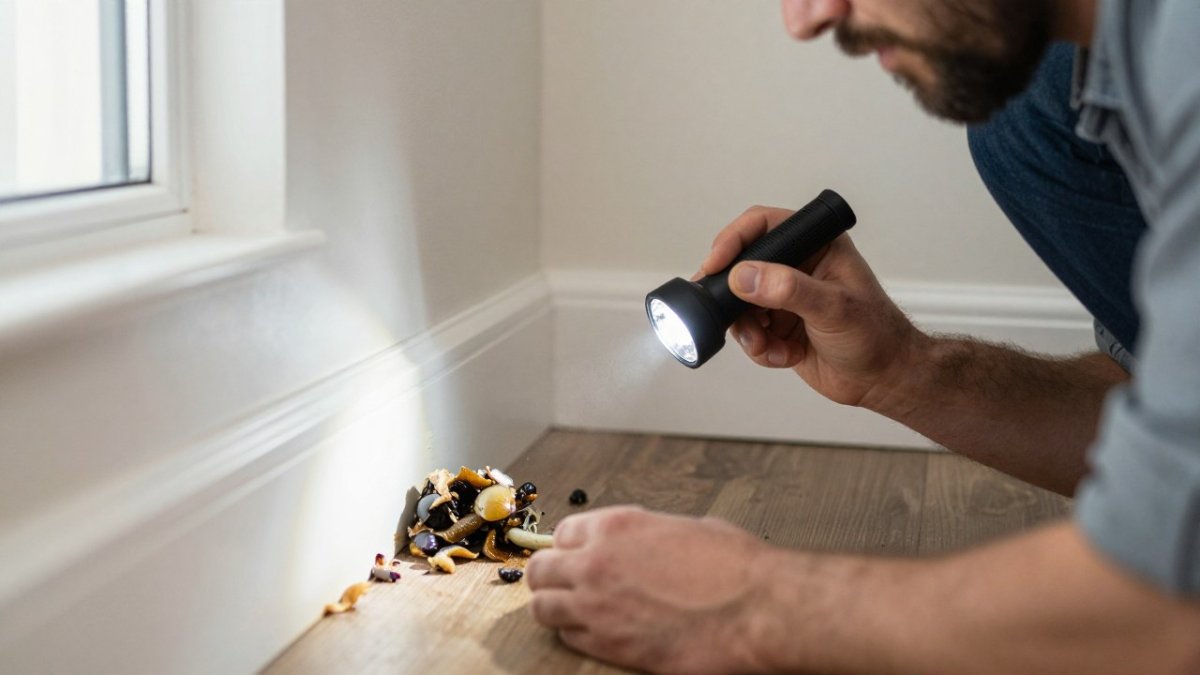
Droppings collect along walls, behind appliances and inside cupboards. Gnaw marks show up on wood, drywall edges, electrical cables and food packaging. Nesting material, such as shredded insulation, paper or fabric, often sits in a hidden corner near a wall void.
- Check under sinks and behind the stove
- Look inside attic hatches and crawlspaces near the wall
- Inspect the edges of cabinets and baseboards for chew marks
Use a flashlight and wear gloves and a mask when you inspect droppings or nesting material. Never sweep droppings into the air, since this can spread germs (the CDC).
Rats in Walls but Not in the House: Why It Happens
Many homeowners hear rats in the walls but never see one in a room. This is normal because rodents prefer hidden routes.
How rodents enter wall voids and cavity walls
Rodents enter through small openings in the exterior of a house (the EPA). Common entry points include:
- Gaps around pipes and vents
- Cracks in the foundation or siding
- Openings where utility lines enter the house
- Overhanging tree branches or climbing plants that touch the building
Once inside, rodents travel along wall cavities, which give them shelter and easy movement between floors.
Rodent Infestation Signs and Odors to Check For
Smell is often the last sign people notice.
A musty or ammonia-like odor can mean urine has built up in a wall space. The smell may be strongest near the wall, in a closet or in a crawlspace. Rodent activity can also contaminate stored food, so check food packages in drawers and cupboards for holes or nibbling.
Quick checks you can do yourself:
- Look for fresh droppings in dark, quiet areas
- Check for new gnaw marks on wood or cables
- Smell the area near suspected wall voids
- Note whether the noise follows a pattern at night
Signs of Rats in the House at Night
Rats are most active after dark. If you hear activity every night around the same time, the animals likely use a fixed route through the walls.
Some common night signs include:
- Scratching behind a wall or inside a ceiling
- Movement near the kitchen or pantry
- Sounds inside a cabinet or under a sink
- Quick footsteps that stop when you walk nearby
Keep a note of when and where you hear the sounds. This helps a professional locate the activity.
Inspecting Without Opening the Wall, and When to Call a Professional
You can confirm activity without cutting into drywall by working through a repeatable sequence: listen, map, check entry points, and look for evidence at the cavity edges. The goal is to decide whether the cavity is active, which species is likely present, and whether the situation is urgent.
A step-by-step inspection you can do safely
- Listen on a schedule. Sit quietly in the room next to the wall for ten minutes after dusk and again before dawn, and note the time, location, and type of sound. Repeat for two or three nights. A pattern that repeats at the same times and moves along the same path suggests a fixed route through the cavity.
- Map the sounds to the structure. Tap the wall gently and note where the sound changes from hollow to solid; rodents often travel along studs, pipes, and the top plate. Compare the sound location with nearby outlets, vents, and plumbing penetrations.
- Check the cavity edges. From the attic, crawlspace, or basement, look along the top and bottom plates, around pipe and wire penetrations, and at the edges of insulation for droppings, rub marks, and shredded nesting material. This is often where evidence is visible without opening the wall.
- Use a tracking patch, not a trap, first. Place a thin dusting of flour or talcum powder along a suspected floor-level run and check it the next morning for tracks. Tracks confirm direction of travel and help you find the entry point.
- Inspect the exterior. Walk the perimeter and look for gaps around pipes, vents, utility lines, foundation cracks, and siding joints, and check for branches or vines touching the building. Entry points are usually found outside, not inside.
Watch out: do not seal a suspected entry point while activity is ongoing, because you can trap rodents inside the cavity, and do not place poison in an inaccessible wall void where you cannot retrieve a dead animal.
What the evidence tells you about urgency
Use the findings to sort the situation into one of three responses.
- Act now: fresh droppings, a strong ammonia or musty odor, visible chew damage on electrical wiring or cable, or a dead-animal smell. Chewed wiring is a fire risk, and odor plus flies often means a dead rodent in the cavity.
- Monitor for about a week: occasional sounds with no new droppings, rub marks, or gnawing. Keep the listening log and recheck the tracking patch before deciding.
- Call a professional: activity continues after your checks, you suspect rats rather than mice, you find damage inside the wall, or you cannot locate the entry point. Persistent nighttime activity and multiple evidence types usually mean an established population rather than a one-off visitor.
What a professional inspection and treatment involves
Rodents inside wall cavities can damage insulation, wiring, and stored food, so it is best to deal with them early. Ekoterra Gopher Pest and Wildlife Control offers eco-friendly pest and wildlife management for homes across Ventura, Los Angeles and Santa Barbara Counties. For current pricing or a quote, contact the company directly through its website, since pricing depends on the property and the work needed.
The article sorts findings into three urgency levels, which a reader can scan at a glance.
| Finding | Response | Why |
|---|---|---|
| Fresh droppings, strong ammonia or musty odor | Act now | Signs of an active or established group |
| Chewed electrical wiring or cable | Act now | Chewed wiring is a fire risk |
| Dead-animal smell with flies | Act now | Suggests a dead rodent in the cavity |
| Occasional sounds, no new droppings or gnawing | Monitor for about a week | Activity may be a brief visit |
| Activity continues after your checks | Call a professional | Suggests an established population |
| Suspected rats, not mice | Call a professional | Rats cause more damage |
| Damage inside the wall or no entry point found | Call a professional | Needs specialist inspection |
Frequently Asked Questions
What are the signs that rats are in a cavity wall?
The most common signs are scratching or scurrying inside the wall, especially after dark, along with droppings near baseboards or in nearby cabinets, gnaw marks on wood or wiring insulation, and nesting material such as shredded paper or fabric. A musty or ammonia-like odor can also point to activity. Several of these signs together are a stronger indication than any single one. For pricing, contact Ekoterra Gopher Pest and Wildlife Control directly through its website, since pricing depends on property size and conditions.
Can mice live in wall cavities?
Yes. Mice and rats both use wall voids as shelter, nesting sites and travel routes because the space is warm, sheltered and connected to the rest of the building through gaps around pipes, vents and wiring. Mice can squeeze through openings about the width of a pencil, so small gaps are enough for entry. Because the activity is hidden, a wall cavity can house a population for weeks before it becomes obvious inside the room.
Do rodents in walls make noise at night?
They are most active at night, so scratching, scurrying and pattering are usually loudest between dusk and early morning. Quiet houses at night make these sounds easier to hear. Noises that come and go with temperature changes are often plumbing or heating rather than animals. A rodent sound typically moves, repeats and includes light gnawing or scrabbling rather than a steady hum or tick.
What should I do if I think rodents are in my walls?
Avoid opening walls or using poison or glue traps inside the cavity, since a trapped or dead animal can cause odor and contamination. Start by checking accessible areas for droppings and entry points, sealing gaps larger than a quarter inch where you can reach them, and placing monitoring traps outside the wall. If activity continues or you cannot find an entry point, consider contacting a professional pest control provider.
